COMPANY REGISTRATION IN INDIA
A practical guide to incorporation, MCA filings and post-registration compliance
Company types • Documents • MCA forms • Incorporation • Post-incorporation • MSME registration
Introduction
Starting a business involves more than choosing a name and finding customers. One early decision is how the business should be legally structured. A small consultancy, a trading firm and a technology startup may have very different needs, so it is worth understanding the available options before registering.
When a company is incorporated in India, it becomes a legal entity in its own right, separate from its shareholders. It can own property, sign contracts and open a bank account in the company’s name. That structure can be useful as a business grows, but it also brings ongoing responsibilities such as maintaining accounts and filing statutory returns.
This article walks through the process in plain language: the main types of companies, the pros and cons of incorporation, the documents you will need, the forms filed with the Ministry of Corporate Affairs (MCA), the work to complete after incorporation and the separate process for Udyam registration.
1. What Is Company Registration?
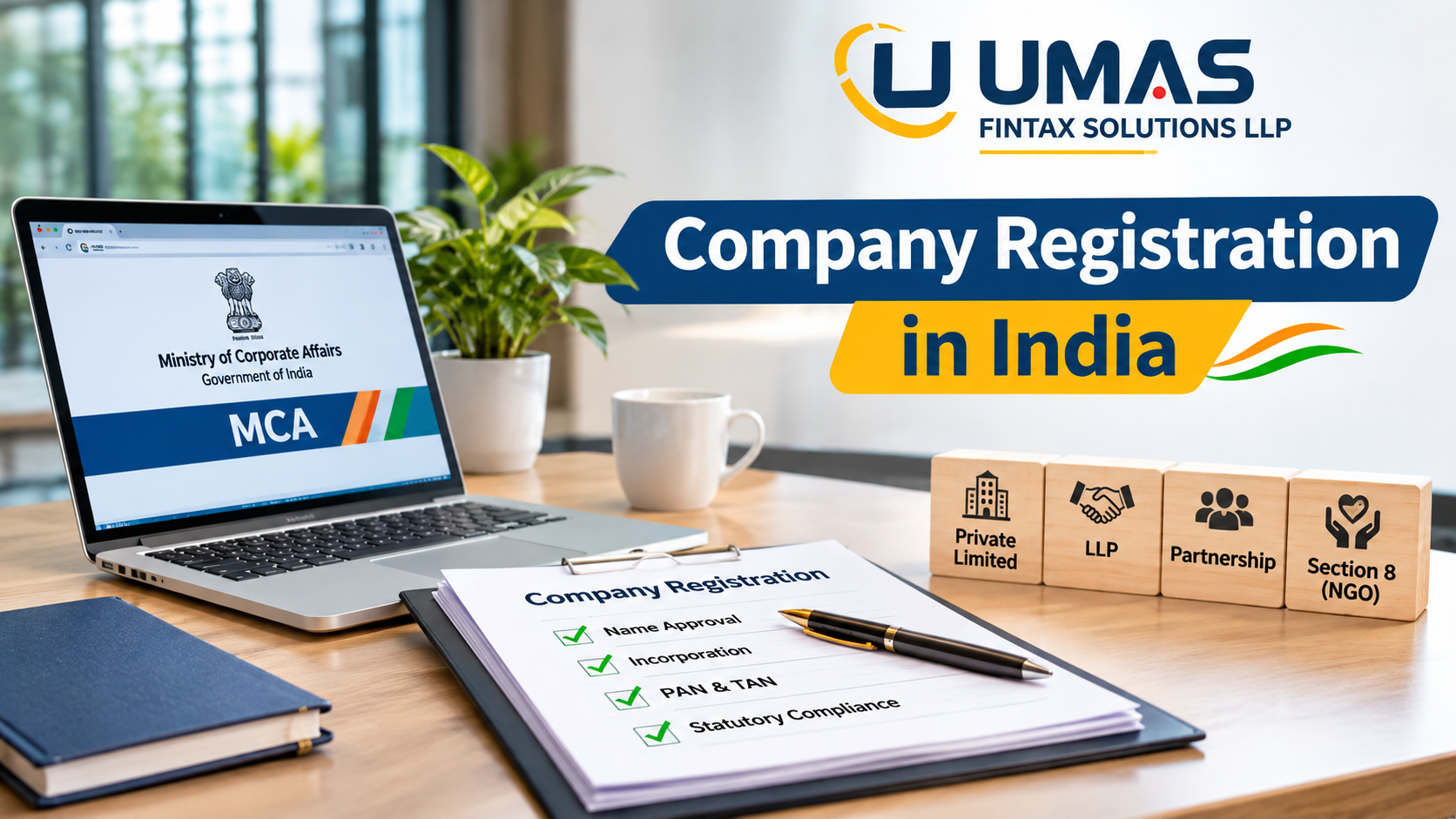
Company registration, more accurately called company incorporation, is the process of creating a company under the Companies Act, 2013. Most applications are filed online through the Ministry of Corporate Affairs (MCA) portal.
Once the application is approved, the Registrar of Companies issues a Certificate of Incorporation and the company is allotted a Corporate Identity Number (CIN). From that date, the company has its own legal identity and can operate in its registered name.
For example, two founders setting up a software business might choose a Private Limited Company. They can hold shares in the company and may also serve as its directors. Client contracts, invoices and other business dealings can then be entered into in the company’s name.
2. Why Do Businesses Register a Company?
-
- Separate legal identity: The company can own assets, enter contracts and conduct business in its own name.
-
- Limited liability: In a company limited by shares, a shareholder’s liability is generally limited to the unpaid amount on the shares held, subject to legal exceptions.
-
- Business credibility: Some customers, suppliers, lenders and institutional clients prefer dealing with a formally incorporated entity.
-
- Continuity: A company has perpetual succession and does not automatically end when a shareholder or director changes.
-
- Investment opportunities: A Private Limited Company can issue shares to eligible investors, subject to company law and securities regulations.
-
- Structured ownership: Shareholding and management roles can be documented clearly.
-
- Access to opportunities: An incorporated business may be eligible for particular tenders, schemes, registrations or finance products, depending on the conditions of each.
3. Types of Companies in India
A. Private Limited Company
A common structure for startups and growing businesses. It generally requires at least two members and two directors, and can have up to 200 members, subject to statutory rules. At least one director must meet the resident-director requirement under the Companies Act.
B. One Person Company (OPC)
An OPC allows one eligible person to form a company as its sole member. It requires a nominee as prescribed by law and at least one director. OPC eligibility and conversion rules should be checked before filing.
C. Public Limited Company
A public company generally requires at least seven members and three directors. It may raise capital from the public only after complying with the applicable Companies Act and securities-law requirements.
D. Section 8 Company
A Section 8 Company is formed for eligible non-profit objectives such as education, social welfare, charity, research, art, science or environmental protection. Its profits, if any, must be applied towards its objects; it cannot distribute dividends to members.
The right structure depends on the number of owners, purpose, funding plans, risk, tax position and compliance capacity. Take professional advice before choosing.
4. Advantages of Company Registration
-
- Separate legal identity from owners.
-
- Limited liability protection for shareholders, subject to exceptions such as fraud, personal guarantees and statutory liabilities.
-
- Better structure for bringing in investors and documenting ownership.
-
- Continuity despite changes in shareholders or directors.
-
- Ability to own property, enter contracts and open accounts in the company’s name.
-
- May improve credibility with some customers, vendors and institutions.
5. Disadvantages and Responsibilities
-
- More statutory compliance than a simple proprietorship, including accounting records, board processes and annual filings.
-
- Incorporation and ongoing costs, including government fees, stamp duty, professional fees and audit costs where applicable.
-
- Companies must maintain books of account and prepare financial statements as required by law.
-
- Annual ROC filings and income-tax compliance continue even when business activity is low or there is no profit.
-
- Directors have legal duties and may face consequences for non-compliance.
-
- Closing a company requires a formal legal process; simply stopping operations does not automatically close it.
6. Basic Requirements for a Private Limited Company
| Requirement | General position |
| Members/shareholders | At least 2 |
| Directors | At least 2 |
| Resident director | At least one director must satisfy the statutory residency requirement |
| Registered office | A valid registered office address in India; supporting proof and owner consent as applicable |
| Company name | Must comply with MCA naming rules and should not conflict with existing company names or trademarks |
| Capital | No general minimum paid-up capital requirement for an ordinary Private Limited Company; decide authorised and subscribed capital |
| Business objects | Clearly describe the proposed lawful business activities |
The requirements differ for OPCs, public companies, Section 8 Companies and other structures. Foreign subscribers or corporate shareholders may need additional documents and authentication.
7. Documents and Information Required
A. Directors and individual shareholders
-
- PAN card for Indian individuals, where applicable.
-
- Aadhaar or other accepted identity proof.
-
- Recent address proof, such as a bank statement or utility bill, as required.
-
- Email address and mobile number.
-
- Photograph or other KYC material if requested by the DSC provider or MCA process.
-
- Digital Signature Certificate (DSC) for persons who must digitally sign the forms.
B. Registered office documents
-
- Recent utility bill or other prescribed address evidence.
-
- Rent or lease agreement if the premises are rented.
-
- No-objection certificate from the owner, where applicable.
-
- Ownership document or other proof if required.
C. Company information
-
- Proposed company name and alternative name choices.
-
- Main business activity and appropriate NIC code.
-
- Registered office address and contact details.
-
- Details of subscribers, shareholding and directors.
-
- Authorised, subscribed and paid-up capital details.
-
- Draft objects and other information for MOA and AOA.
The exact attachments depend on the company type, the status and nationality of subscribers, and the facts of the proposed incorporation.
8. Step-by-Step Company Incorporation Process Through MCA
Step 1: Obtain Digital Signature Certificates (DSCs)
A DSC is an electronic signature used to sign and authenticate online forms. The proposed directors and subscribers who are required to sign incorporation documents should obtain the appropriate DSC from a licensed Certifying Authority. Complete the provider’s KYC and follow the current MCA signing requirements.
Step 2: Reserve the company name – SPICe+ Part A
Log in to the MCA portal (https://www.mca.gov.in/) and access the SPICe+ service. Enter the proposed name, company type, main activity and other requested details. Check existing company names and trademarks before applying. Keep alternative names ready. Name reservation may be filed separately or as part of the integrated incorporation workflow, as permitted by the portal.
Step 3: Prepare the Memorandum of Association (MOA)
The MOA sets out the company’s name, state of registered office, objects, liability, capital and subscriber details. The objects should accurately describe the activities the company intends to carry on. The electronic MOA is generally filed as INC-33 where the e-MOA process applies.
Step 4: Prepare the Articles of Association (AOA)
The AOA contains the company’s internal management rules, including provisions on shares, transfers, directors, board meetings, general meetings, voting and dividends. The electronic AOA is generally filed as INC-34 where the e-AOA process applies.
Step 5: Complete SPICe+ Part B (INC-32)
SPICe+ Part B is the main integrated incorporation application. It captures the company details, registered office, capital, subscribers, directors and other particulars. It also facilitates allotment of DIN to eligible proposed directors who do not already have one, subject to the applicable limits and rules. PAN and TAN applications are integrated into the incorporation process.
Step 6: Complete INC-9 declaration
INC-9 contains declarations by subscribers and first directors as prescribed. It is generally generated electronically where the applicable conditions are met. Check the declarations and details carefully before submission.
Step 7: Complete AGILE-PRO-S (INC-35)
AGILE-PRO-S is a linked form used to apply for certain registrations and services, depending on the options and applicability. It can include GST registration, EPFO and ESIC registration, certain state Professional Tax registrations, bank account application and other supported services. The availability and legal applicability of each registration must be checked. GST is not automatically compulsory for every newly incorporated company.
Step 8: Upload, digitally sign and pay
Attach the required supporting documents, validate the forms, obtain the required digital signatures and submit the linked forms through MCA. Pay the applicable filing fees and stamp duty. Save the Service Request Number (SRN) and monitor the application. If the Registrar raises a resubmission, correct the issue within the stated time.
Step 9: Receive the Certificate of Incorporation
After approval, the Registrar of Companies issues the Certificate of Incorporation and the company receives its CIN. PAN and TAN are generally allotted through the integrated incorporation process. Download and securely retain the certificate, approved constitutional documents and filing acknowledgements.
9. Main MCA Forms Used for Incorporation
| Form / service | Purpose |
| SPICe+ Part A | Reservation of proposed company name |
| SPICe+ Part B (INC-32) | Integrated company incorporation application |
| INC-33 | Electronic Memorandum of Association, where applicable |
| INC-34 | Electronic Articles of Association, where applicable |
| INC-9 | Declaration by subscribers and first directors |
| AGILE-PRO-S (INC-35) | Linked applications for specified registrations and services |
| INC-3 | Nominee consent for an OPC, where applicable |
| INC-13 / INC-31 | Prescribed MOA/AOA formats for Section 8 Companies, where applicable |
Not every form applies to every company. The MCA portal’s current integrated workflow determines the forms and attachments required for the specific incorporation.
10. Post-Incorporation Compliances: What to Do After Registration

Illustration: Key post-incorporation activities, including share certificates, banking, audit and statutory compliance.
The Certificate of Incorporation is the starting point, not the final task. The directors still need to complete a number of formalities, some within strict time limits. The steps below are a practical checklist; check which requirements apply to the particular company.
Step 1: Verify the registered office
Every company must have a registered office capable of receiving official communications. If the registered office was not fully verified at incorporation, file INC-22 within the applicable period (generally 30 days). Attach the prescribed utility bill, proof of ownership or rent/lease documentation and owner consent, as applicable.
Step 2: Hold the first Board Meeting
Under Section 173, the first Board Meeting must generally be held within 30 days of incorporation. The Board may take note of the incorporation documents, approve the opening or operation of the bank account, appoint the first auditor, authorise statutory filings, consider preliminary expenses and address other initial matters. Prepare and preserve the minutes and notices in accordance with the Act and applicable rules.
Step 3: Appoint the first auditor
Under Section 139(6), the Board of Directors must appoint the first auditor of a non-government company within 30 days of registration. If the Board fails, the members must appoint the auditor at an extraordinary general meeting within the prescribed further period. The first auditor holds office until the conclusion of the first AGM.
Obtain the auditor’s written consent and eligibility confirmation and pass the required Board resolution. Form ADT-1 is generally not required for the first auditor appointed under Section 139(6); check the applicable rules for subsequent appointments.
Step 4: Open the company bank account and receive subscription money
Open or activate the company’s current account using the incorporation documents and bank KYC requirements. Each subscriber should pay the amount agreed to be taken on the shares into the company account. Retain bank statements and payment evidence. This payment is important for the commencement-of-business declaration under Section 10A, where applicable.
Step 5: File commencement-of-business declaration – INC-20A
Under Section 10A, a company having share capital and covered by the provision must file Form INC-20A within 180 days of incorporation. The declaration confirms that every subscriber to the MOA has paid the value of the shares agreed to be taken.
The company should ensure that subscription money has been received and that the required professional certification and supporting information are in place before filing. A company covered by Section 10A must not commence business or exercise borrowing powers until the declaration is filed. INC-20A does not apply to a company incorporated without share capital.
Step 6: Issue share certificates to subscribers
Under Section 56(4), share certificates must generally be delivered to subscribers to the MOA within two months from the date of incorporation. A share certificate is the company’s evidence of the shares held by a member.
The certificate should contain the prescribed particulars, including the company’s name and CIN, shareholder’s name, number and class of shares, distinctive numbers, amount paid, certificate number and issue date. It must be executed by the authorised signatories and stamped in accordance with applicable stamp law. Later allotments have separate timelines.
The company should also enter the shareholder’s details in its Register of Members and maintain the relevant share and statutory records. Keep copies of certificates and proof of delivery.
Step 7: Complete applicable stamp duty
Stamp duty applies to share certificates under the applicable stamp law and collection mechanism. Confirm the current rate, payment method and timing applicable to the company’s circumstances. Retain the payment evidence.
Step 8: Maintain statutory registers and records
Maintain the Register of Members, registers of directors and key managerial personnel, relevant contracts and charges registers where applicable, Board and general meeting minutes, books of account and other statutory records. The location and form of maintenance must comply with the Act and rules.
Step 9: Complete other registrations
Apply for GST, Shops and Establishments, Professional Tax, EPFO, ESIC, FSSAI, IEC or other registrations only where the relevant business activity, employee strength, turnover, state law or other trigger makes them applicable. Udyam registration is a separate MSME registration and is generally optional.
Step 10: Continue regular compliance
The company must prepare financial statements, arrange statutory audit, hold Board and general meetings, file annual returns and financial statements and complete tax and other applicable filings. A company should not assume that nil business activity removes all compliance obligations.
11. Post-Incorporation Compliance Timeline
| Compliance | Provision / form | General timeline |
| First Board Meeting | Section 173 | Within 30 days of incorporation |
| Appointment of first auditor | Section 139(6) | Within 30 days of registration |
| Registered office verification, if required | INC-22 / Section 12 | Generally within 30 days, where applicable |
| Receipt of subscriber share money | Section 10A | Before filing INC-20A, where applicable |
| Commencement-of-business declaration | INC-20A / Section 10A | Within 180 days, where applicable |
| Delivery of share certificates to subscribers | Section 56(4) | Within 2 months of incorporation |
| First AGM | Section 96 | Within 9 months from close of first financial year |
| Financial statements filing | AOC-4 | Generally within 30 days of AGM |
| Annual return | MGT-7 / MGT-7A | Generally within 60 days of AGM |
These are general statutory timelines, not a substitute for checking the exact provision, applicable rules, exemptions and event-specific due dates for each company.
12. MSME (Udyam) Registration After Incorporation
After incorporation, an eligible company may register as a Micro, Small or Medium Enterprise through the Udyam Registration Portal of the Ministry of MSME. Udyam registration is separate from company incorporation and is not required merely to create a company.
The MSME classification is based on the applicable investment and turnover criteria. The current general classification thresholds are:
| Enterprise category | Investment in plant, machinery or equipment | Annual turnover |
| Micro | Not more than ₹2.5 crore | Not more than ₹10 crore |
| Small | Not more than ₹25 crore | Not more than ₹100 crore |
| Medium | Not more than ₹125 crore | Not more than ₹500 crore |
Both investment and turnover criteria are considered for classification. Verify the latest official Udyam rules and any amendments before advising a client.
Benefits of Udyam registration
-
- Recognition as a registered MSME.
-
- Access to eligible government schemes and support programmes.
-
- Potential benefits under delayed-payment provisions for qualifying micro and small enterprises.
-
- Eligibility for certain procurement preferences or credit-related schemes, subject to their conditions.
Information generally needed
-
- Aadhaar details of the authorised signatory, as applicable.
-
- Organisation PAN and GSTIN, where applicable or required.
-
- Company name and CIN.
-
- Registered office and business address.
-
- Bank account number and IFSC.
-
- Business activity and appropriate NIC code.
-
- Employee details and other information requested by the portal.
How to apply for Udyam registration
-
- Visit the official portal: https://udyamregistration.gov.in/.
-
- Choose the option for a new entrepreneur who is not registered yet.
-
- Enter the Aadhaar details of the authorised signatory and complete OTP verification.
-
- Enter and verify the organisation’s PAN details.
-
- Provide GSTIN details where applicable or required.
-
- Enter company, address, bank and business activity details.
-
- Select the appropriate NIC code and provide employment information.
-
- Review the information, submit the declaration and complete OTP verification.
-
- After successful processing, download the Udyam Registration Certificate and retain the Udyam Registration Number.
The official Udyam registration process is free. Avoid unofficial websites that charge a fee for submitting the government registration application.
13. Other Registrations That May Be Required
| Registration | When it may be relevant |
| GST registration | When turnover, activity or another statutory condition makes registration compulsory, or where voluntary registration is chosen. |
| Shops and Establishments | As required under the relevant state law. |
| Professional Tax | Where applicable under state law. |
| EPFO | When the establishment is covered under the EPF law or another applicable trigger. |
| ESIC | When the establishment and employees are covered under ESI law. |
| FSSAI | For food businesses, according to the applicable licence/registration category. |
| Import Export Code (IEC) | Generally for businesses undertaking import or export activities, subject to applicable exceptions. |
| Startup India recognition | For eligible startups that meet the recognition criteria. |
Do not apply for every registration automatically. First assess the company’s business, location, employees, turnover and legal obligations.
14. How Much Does Company Registration Cost in India?
There is no single fixed price for every incorporation. The total cost may include DSC charges, MCA filing fees, state stamp duty, name reservation charges where applicable and professional fees. The amount depends on the company type, authorised capital, state, number of subscribers and the documents required. For End to End Company registrations cost starts from 20,000/- to 30,000/- (this rates in the year 2026)
Check the latest MCA fee schedule and applicable state stamp duty before quoting a client. Also explain that annual audit, accounting, tax and ROC compliance costs continue after incorporation
15. Frequently Asked Questions
Can one person register a company in India?
Yes. An eligible individual can incorporate an OPC, subject to the nominee and other statutory requirements.
What is the minimum number of directors in a Private Limited Company?
A Private Limited Company generally requires at least two directors.
Is a registered office compulsory?
Yes. Every company must have a registered office in India capable of receiving official communications.
Is GST registration compulsory for every newly incorporated company?
No. GST registration depends on the applicable turnover thresholds, nature of supply, business activity and other statutory conditions.
Is Udyam registration compulsory?
No. Udyam registration is generally optional for an eligible enterprise, although it may help the enterprise access benefits for which it qualifies.
What is the difference between MOA and AOA?
The MOA sets out the company’s fundamental details and objects. The AOA contains rules for the company’s internal management.
How long does company registration take?
The time depends on name approval, document readiness, verification and MCA processing. Errors or resubmissions can extend the timeline; avoid promising a fixed number of days.
Can a residential address be used as the registered office?
It may be possible if the premises can legally be used for that purpose and the required address proof and owner consent are available.
When must the first auditor be appointed?
For a non-government company, the Board generally appoints the first auditor within 30 days of registration under Section 139(6).
When must INC-20A be filed?
A company having share capital and covered by Section 10A must file INC-20A within 180 days of incorporation, after subscribers have paid the agreed share amounts.
When should share certificates be issued?
Certificates to subscribers to the MOA must generally be delivered within two months from incorporation. Later allotments have separate timelines.
Is ADT-1 required for the first auditor?
ADT-1 is generally not required for the first auditor appointed by the Board under Section 139(6). Check the applicable requirements for subsequent appointments.
16. Conclusion
Incorporating a company can be a sensible choice when the owners want a separate legal entity, clearly recorded shareholding and a structure that can support future growth. The right choice depends on the nature of the business, the people involved and the level of compliance they are prepared to manage.
After incorporation, attention should turn to the first Board Meeting, appointment of the first auditor, receipt of share subscription money, filing of INC-20A where required and delivery of share certificates to the subscribers. The company must also keep its statutory records up to date and meet the tax, labour and annual ROC filing requirements that apply to it.
An eligible business can also apply separately for Udyam registration. It is worth treating incorporation and ongoing compliance as connected parts of running a company: getting the paperwork right at the beginning can help avoid corrections, missed deadlines and unnecessary costs later.
Suggested Internal Links
-
- Private Limited Company Registration service page
-
- GST Registration in India
-
- MSME Udyam Registration
-
- LLP Registration in India
-
- Section 8 Company Registration
-
- Accounting and Bookkeeping Services
Suggested Official External References
-
- Ministry of Corporate Affairs: https://www.mca.gov.in/
-
- Companies Act, 2013: https://www.mca.gov.in/Ministry/pdf/CompaniesAct2013.pdf
-
- Udyam Registration Portal: https://udyamregistration.gov.in/
-
- Startup India: https://www.startupindia.gov.in/
Disclaimer: This article is for general educational and informational purposes only and is not legal, tax or professional advice. Laws, forms, fees, thresholds and filing procedures may change. Readers should verify current requirements on the relevant government portals and consult a qualified professional before taking action.
About UMAS FINTAX SOLUTIONS LLP
UMAS FINTAX SOLUTIONS LLP works with entrepreneurs, startups and established businesses on company and business registrations, accounting, bookkeeping, taxation and statutory compliance. The team brings over 20 years of industry experience and helps clients understand the registrations and ongoing requirements relevant to their businesses.
Our services include:
-
- Section 8 Company and NGO-related registration support
-
- GST registration and compliance
-
- MSME (Udyam) registration
-
- Income Tax and TDS return filing
-
- ROC and MCA compliance
-
- Accounting, bookkeeping and payroll services
Learn more about our services: www.umasfintax.com